 Blasterswap
: swap and pool position choices on Blast
Blasterswap used V2 pool shares and V3 range positions to connect token swaps with liquidity on Blast. Swapping changed the tokens held; providing liquidity created continuing exposure to a pool. For V3 providers, swap fee participation depends on liquidity being active within the selected range. Blast has entered a network wind-down, so current position decisions also involve recovering transferable tokens and completing a separate withdrawal to Ethereum. Any present use requires access to the relevant contracts and the network services needed for execution.
Last updated ·Pool balances connect swaps and liquidity positions
Trading and liquidity provision both rely on assets held by pool contracts, although they leave different holdings behind. A swap exchanges an input token for an output token. V2 liquidity provision creates shares in the pair's balances. A V3 position records liquidity over selected tick boundaries, which define its price range. Collecting accrued V3 tokens is another distinct operation: it pays an existing entitlement without necessarily changing the position's liquidity.
Traders changing assets use a swap to receive output tokens. Providers seeking pool exposure hold V2 shares or a managed V3 position with a chosen range. V3 owners collecting accrued tokens can retain their liquidity. Providers recovering capital redeem V2 shares or reduce a managed V3 position and then collect its owed tokens.
Swap output and pool ownership measure different outcomes
A completed exchange changes token balances, while a liquidity deposit creates a continuing claim that changes with the pool.
Exchanged tokens
The V2 pair records input and output amounts in its Swap event after enforcing its reserve and invariant checks. In V3, the pool returns signed token amounts that distinguish assets received by the pool from assets sent out. These records describe an exchange. They do not create a liquidity position for the trader. A quoted output remains an estimate until the relevant swap executes, and available liquidity limits what the exchange can deliver.
Continuing pool claims
V2 ownership follows the holder's share of the liquidity provider (LP) token supply. A V3 position held through the position manager uses an ERC-721 position NFT with its own liquidity, range and tokens-owed accounting. Depositing assets therefore changes the form of the holding. The value and composition of that claim can change before redemption, even if its identifying token remains the same.
V2 shares retain exposure to the pair's changing balances
V2 liquidity represents a proportional claim on the pair's current assets, without a provider-selected price range. Redemption calculates each token amount from the liquidity being burned, the pair's balances and the total LP supply. Trading changes the proportions held inside the pair, so the amounts returned can differ from the original deposit. For a task that requires a specific token balance, redeeming liquidity and exchanging one of the returned assets have different purposes.
Holding the underlying tokens separately avoids that pool rebalancing. It also gives up the pool claim through which retained trading fees affect redemption amounts.
V3 ranges tie trading fee participation to the current tick
A V3 position with liquidity participates in swap fee growth when the current tick is at least its lower boundary and below its upper boundary.
Active range
Within the selected range, the position contributes to the liquidity that a swap uses. The pool tracks fee growth, and the position manager uses the position's liquidity to calculate its entitlement. An NFT balance alone does not describe that participation. The useful comparison is between the current tick and the stored lower and upper boundaries, together with the amount of liquidity still assigned to the position.
Outside the range
Outside its range, the position stops participating in new swap fee growth at that price. Previously accrued amounts remain separate from that change in participation. Moving outside the range does not delete the NFT or automatically transfer its assets to the owner. The remaining position can still be reduced and its owed tokens collected through the manager, subject to authorization and the relevant amount checks.
Trading fees and native yield affect different calculations
The documented V2 pair applies a 0.3% swap fee to the input amount in its invariant calculation. That fee describes the cost within the pair, while network gas pays for execution. V3 pools use their own configured fee parameter, so the V2 percentage cannot describe every V3 exchange.
Native yield adds another accounting difference. V2 claims eligible USDB and WETH yield into the pair's balances during liquidity minting and burning. V3 adds claimed yield to fee-growth accounting when updating positions, using active pool liquidity when it is nonzero. These mechanisms can affect a liquidity claim. They do not establish a fixed return, and accrued yield should not be confused with tokens that a collection has already paid.
V3 parameters constrain liquidity reduction and collection
The V3 manager checks position authority and requested amounts before a liquidity reduction can complete. Its parameters describe the position being changed and the token amounts that the caller will accept. Minimum amounts apply to the underlying tokens returned by the reduction calculation. A position's liquidity value is a separate accounting quantity, so it should not be read as a wallet token balance.
| V3 parameter | Condition enforced by the manager |
|---|---|
tokenId
|
Reduction and collection require the NFT owner or an approved operator. |
liquidity
|
A reduction must request more than zero and no more than the position's recorded liquidity. |
amount0Min
|
The token0 amount from a reduction must meet or exceed this minimum. |
amount1Min
|
The token1 amount from a reduction must meet or exceed this minimum. |
amount0Max
|
Collection of token0 is capped by this maximum and the amount owed. |
The collection call also carries an
amount1Max
ceiling for token1. Those collection ceilings govern payment of owed amounts; they do not reduce the position's liquidity. Deadline checks also apply to the manager's liquidity-changing calls.
Can accrued V3 fees be collected without removing liquidity?
Yes, the V3 manager can collect owed tokens while the position retains liquidity, provided the caller has authority.
When liquidity remains, collection triggers a zero-liquidity burn in the core pool to refresh fee accounting. That core call updates the entitlement without reducing the position. The manager then requests payment, subject to the collection ceilings. Recovering deposited capital also requires a liquidity reduction; collection alone leaves the remaining liquidity in place.
A V3 exit separates token recovery from NFT removal
Recovering a V3 position's assets involves reducing liquidity and collecting the resulting amounts owed. A reduction calculates the underlying token amounts and updates the position's liquidity. Collection sends owed tokens to the designated recipient. Reducing liquidity alone does not establish that those tokens have reached a wallet.
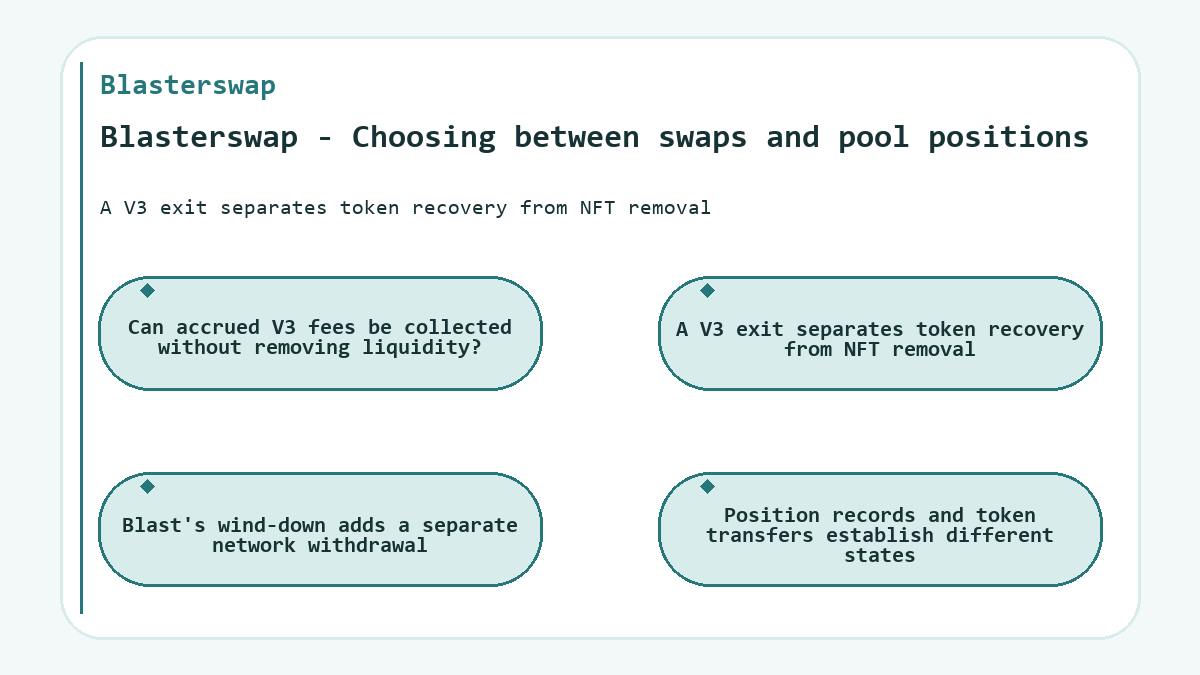
Blasterswap - Choosing between swaps and pool positions
- Can accrued V3 fees be collected without removing liquidity?
- A V3 exit separates token recovery from NFT removal
- Blast's wind-down adds a separate network withdrawal
- Position records and token transfers establish different states
During a reduction, the manager calls the pool's burn function for the selected range. It checks the returned amounts against the minimum amounts. The manager then adds the withdrawn principal and newly accounted fee entitlement to its tokens-owed fields. Those fields can therefore contain more than trading fees, which matters when interpreting a displayed collection amount.
Collection requests payment from the pool and reduces the recorded entitlement by the requested collectible amounts. The recipient parameter determines where payment goes. An amount owed, an amount requested and an amount actually returned describe different parts of that operation.
Burning a V3 position NFT requires zero remaining liquidity and zero recorded tokens owed. This final burn removes the empty ownership record. It does not perform the liquidity reduction or token collection. Keeping an empty NFT and holding an active position are different states, so the presence of the NFT cannot establish how much capital remains deposited.
The operations have an accounting order, but their function names alone do not establish separate wallet transactions. An interface may group supported calls; its actual execution must preserve the manager's conditions.
Blast's wind-down adds a separate network withdrawal
Tokens returned from a pool remain on Blast until a supported withdrawal moves them to Ethereum. Blast's wind-down notice asks holders to bridge their assets back to Ethereum as soon as possible. A pool exit changes ownership of underlying assets within the network. It does not complete the bridge's proof, waiting period or destination-chain claim. A swap may change which supported asset is held. V2 redemption transfers underlying tokens, while V3 liquidity reduction records amounts that still require collection.
For regular wallets, the withdrawal flow requires gas on both networks. WETH must first be unwrapped to ETH on Blast; USDB withdraws as DAI on Ethereum. The documented ETH flow includes a one-day challenge period after proving the withdrawal. USDB requires finalization after that period and a separate DAI claim following up to one additional day of processing. Smart contract wallets require a different withdrawal path from the bridge website. These conditions belong to the network withdrawal, and a pool redemption does not satisfy them. Their practical use depends on the required network services remaining available.
Position records and token transfers establish different states
The position manager's recorded liquidity shows remaining pool exposure, while its tokens-owed fields show an entitlement awaiting collection. Neither field proves payment to the NFT owner's wallet. A successful collection identifies a recipient and returns actual token amounts. A transfer to the position manager is also different from a transfer to the owner. Reconciling these states prevents an existing claim from being counted again as a received balance, particularly after liquidity reduction adds principal to the collectible amount.
Keeping liquidity or preparing tokens for withdrawal
Keeping a pool position makes later recovery depend on usable V2 redemption or V3 reduction and collection. During Blast's wind-down, that assessment includes access to a supported network withdrawal. A swap may convert a recovered token to an asset accepted by the withdrawal path if a suitable route exists. WETH can be unwrapped to ETH without a swap. If the holding already meets the withdrawal requirements, an additional swap introduces another execution dependency.
Frequently asked questions about Blasterswap
Can a Blasterswap V3 deposit require only one pool token?
The V3 pool can require only one token when the position's range lies outside the current tick. Below the lower tick, the mint calculation requires token0; at or above the upper tick, it requires token1. Within the range, it calculates contributions from both tokens. This is a property of the selected range and pool state, so a liquidity deposit should not be assumed to require equal token quantities.
Does adding liquidity change a Blasterswap V3 position's price range?
The manager's increaseLiquidity function keeps the position's existing lower and upper tick boundaries. It reads the stored range when adding liquidity and increases the liquidity recorded for that NFT. Choosing different boundaries requires a position with those boundaries.
Is prior fee collection required before increasing a V3 position?
The increaseLiquidity function accounts for accrued fees without requiring a preceding collection call. It adds the entitlement to the position's tokens-owed fields before updating its recorded liquidity. Those amounts remain available for collection under the manager's authorization rules. A successful increase establishes that liquidity changed, while payment of the accrued tokens remains a separate operation.
Who can choose the recipient of a V3 collection?
The NFT owner or an approved operator can specify the recipient in a collect call. That recipient can differ from the NFT owner. If the caller supplies the zero address, the manager directs collection to itself. The manager's position fields can be read without granting collection authority.
Why can a V3 Collect event differ from the returned token amounts?
Rounding in the core pool can make the actual returned amounts slightly smaller than the manager's Collect event amounts. The manager emits the requested collectible amounts and subtracts those amounts from its recorded entitlement. Its return values come from the pool's actual collection. The event values should therefore not automatically be treated as the exact amounts received.
How can a V3 swap leave part of the specified input unused?
In an exact-input V3 swap, the core pool stops at the specified price limit even if some input remains unused. Its loop also stops when the specified amount is exhausted. Returned token amounts describe the exchange that actually executed. Any additional minimum-output condition or handling of unused funds depends on the calling router method, so the core behavior does not establish an interface's complete result.
Will every Blasterswap V2 swap fee accrue entirely to existing liquidity shares?
Existing liquidity shares can be diluted when the V2 factory's protocol-fee recipient is enabled. The pair can mint additional LP shares to that recipient during liquidity events when its growth conditions are met. This affects how existing holders share the pool's assets. The pair's input swap fee alone therefore does not establish the entire entitlement of existing liquidity providers.